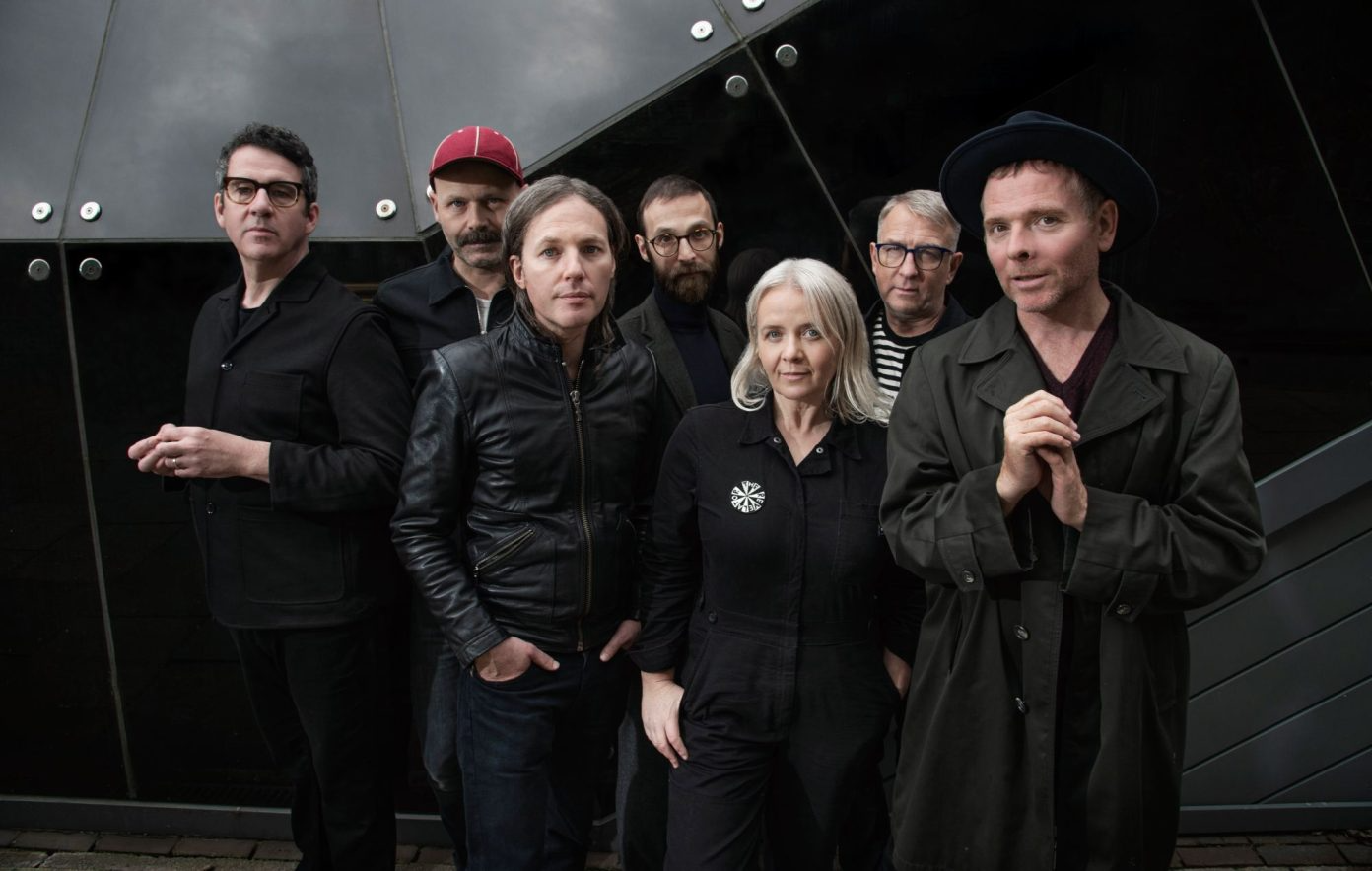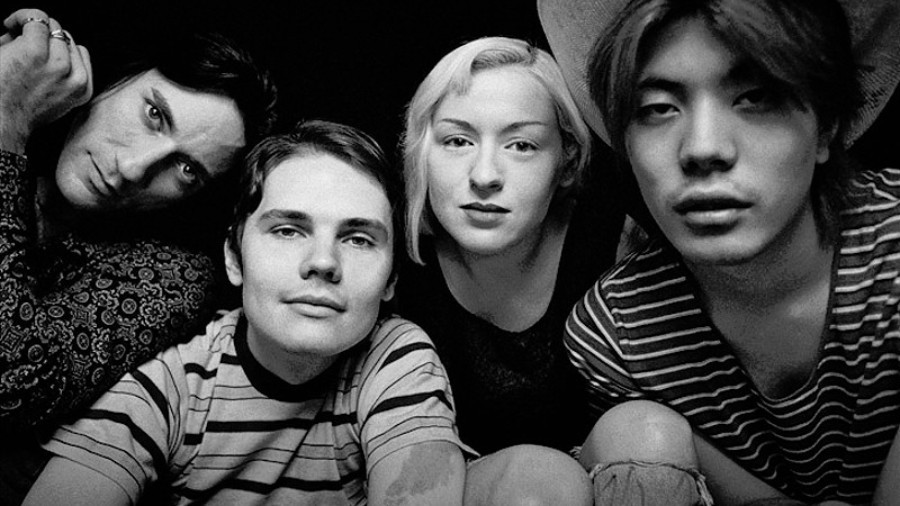


Fuck off! Off!” Bill Ryder-Jones barks gently but sternly, swatting at the hand looming over the synth in front of him. Beside him, James Balmont pulls back, the mischief running through his fingers extinguished as he’s scolded like a puppy whose energy is becoming a bit too distracting. As Swim Deep’s keyboardist slinks back to his seat, he protests through a mock pout: “I was going to play the X-Files theme!”
It’s late August 2025, and Swim Deep have decamped to Brussels’ ICP Studios to work on their fifth album, ‘Hum’. After helming 2024’s ‘There’s A Big Star Outside’, Ryder-Jones is back in the producer’s chair, and alongside engineer Giovanni Lando, the cohort are entering the final stages of recording when NME joins them in Belgium.
Over the two weeks that Balmont, frontman Austin “Ozzy” Williams, drummer Thomas Fiquet and new guitarist J.J. Buchanan have spent in the wood-panelled studio (bassist Cavan McCarthy has had to sit out the trip due to childcare commitments), progress has been good. The band are in good spirits, but a slight undercurrent of tension starts to build in the 24 hours NME spends in their company. In a few days’ time, they’ll return to the UK. Before then, fat needs to be trimmed, details nailed down, and ideas fleshed out until each song reaches its maximum potential. The clock is ticking, and each time they listen back to a track, a discussion follows about what needs fixing, adding or taking away.
Once the layers and details are worked out, though, the world is in for a treat. Even on first, unfinished listen, it’s clear that this album is shaping up to be something beautiful. As Williams leaves the room to work on something by himself, the rest of the band play through a handful of tracks for NME – the results of a “purple patch” of songwriting between the frontman and Buchanan. “Each song should go on a journey,” Balmont shares as one track fades out of the speakers, calling the notion one of this album’s “guiding lights”. You can sense that approach in the likes of the slow, grungy stomp of ‘Mud’ and the emotive beauty of the Buchanan-penned ‘Broken’ – songs that grow, change and weave stories.
While there’s often a marked difference between each Swim Deep album, here they dig deeper into the sound of ‘There’s A Big Star Outside’ – softer, grungier, more songwriterly. Lyrically, it’s introspective but accessible, filled with personal reflections that are moving, but also make you consider where you are in your own life. On the bright, bursting ‘You, Me & Mary’, a touching contemplation directed to his wife and one-year-old daughter, Williams wonders with infectious self-observation: “Is this the best that I can be?”
ICP Studios is a fitting place for these reflections to unfold. It’s a space Swim Deep have visited at several points in their journey, first setting foot inside in 2012 when, as a rising act backed by plenty of buzz, they came to record their debut album, ‘Where The Heaven Are We’. “That first year, [we were signed to a] major label, [had] three meals a day, private chef, all that stuff,” Williams recalls. When they came back to record follow-up ‘Mothers’ in 2014, there was “one less meal [a day], [the label were] a bit more cautious with us”. In the evening, as we walk to a bowling alley imaginatively named Brussels Bowling – a consistent fixture in the band’s visits to the city – Balmont regales us with youthful tales of drunken festive nights, dragging Christmas trees to the studio, and “tops off in the club” for one of Williams’ birthdays past.
In 2023, they returned to make ‘There’s A Big Star Outside’, no longer those responsibility-free kids but adults in their thirties. At that time, Williams was about to become a father; his experience of that then-impending reality becoming actualised colours ‘Hum’. When NME visits the band, his daughter Mary and partner Nell have also come over to be together for a few days between sessions, reinforcing that sense that the studio is somewhere the band have grown up.
Across ‘Hum’, Williams meditates on family and the ties that bind us together, the shift that comes both with a new life and the grief of departures. In the same month Mary was born, Nell’s father died – a combination of seismic life events the musician calls “mind-splitting”.

“Mary was the thing that brought anyone joy in that time,” he says, slouched in a booth at Brussels Bowling after a chaotic round on the lanes (Williams comes out on top; NME and Fiquet hold up the bottom end, despite frantically studying bowling tutorials on YouTube to aid our game). “You’re mourning, you’re trying to be sensitive, and you don’t want to put any of that on the child. A lot of growth came with that and the songs came out of that.” This album, he half-jokes, is one that can be summed up as “live, loss, love”: “The love makes the loss harder, but the love makes the live easier.”
Through that world-uprooting time, the experience of becoming a dad has reminded him of the purpose of the path he’s chosen. “With Mary, I just write my songs like nursery rhymes or whatever,” he explains fondly. “It brings you back to what songwriting is about – sharing stories and keeping stories memorable for people with melody.”
Around the time of Mary’s birth, Williams questioned whether continuing to make a living from music was “the right thing to do” or if he should find a more stable way to provide for his family. It’s the kind of conundrum that’s plagued many musicians, the financial insecurity of band life causing Swim Deep to lose some members over the years. Today, each of the five bandmates works a day job alongside the band – a necessity that also means they can’t be a “proper band” because their clashing schedules make it impossible to rehearse.
Why, then, do they keep going? “I think 10 years ago, a big part of making music was trying to get recognition,” Balmont reasons the next morning as the band gather around a table in a room lined with plaques celebrating albums made at ICP. “I think now, we’re pursuing creative satisfaction as a more personal thing.” He nods to an interview he did with Flaming Lips’ Wayne Coyne a few years back in his day job as a culture journalist. “I remember him telling me, ‘When you get to this age, it’s not about just being with the lads anymore and having a good time – you’ve really got to love the music.’ I feel like that’s a realisation we’ve come to and that’s maybe why we are still here.”
“Me and Cav have always said that our day will come – we just don’t know when” – Austin Williams
“But also, what would we do if we weren’t doing this?” Fiquet says in a tone that suggests there is no alternative for him. “I’ve never not been in a band since I was 15, except for one month when I lived in London. I wouldn’t know what to do.”
“I saw someone in a band that makes a lot of money say, ‘All of our peers have given up’,” Williams adds. “It’s like, ‘Well, yeah, obviously – they haven’t been making money.’ It does feel sometimes like we’ve been left on the shelf, but I think it’s really important that we carry on to show that it’s possible for bands to do that.”
For those who believe in the band – whether fans, peers or colleagues – Swim Deep still elicit a huge passion. As we wait for our lane to be ready at the bowling alley, Ryder-Jones waxes lyrical to NME about the band’s talents in a way that could convince the staunchest non-believer. Midway through, he makes eye contact with Williams at the bar behind us, a bemused look on the frontman’s face. “She didn’t ask, but she wanted to know – I could see it in her eyes,” Ryder-Jones grins.
The next day, the producer isn’t quite as buoyant, that ticking clock getting ever louder. “It feels like there’s still a lot of work to be done,” he sighs, taking a drag of a cigarette. “It still feels like we haven’t quite cracked some things.” Whether they have time left to tend to those areas remains to be seen, but he’s sure of one thing. “They’re definitely going in the right direction. Sometimes it takes two or three records to settle into a new era. It can be a challenge to your audience, so you [just have to] keep putting out good quality records, which I think we are doing.”

‘Hum’ might not mark a fresh chapter for the band in terms of sound, but it feels like their energy has been refreshed by the addition of Buchanan. The new guitarist officially came into the line-up in spring 2025 after Robbie Wood had to quit due to the financial constraints of the band. “It’s completely changed the band, in my opinion,” Williams enthuses. “We never really want to use session musicians because, as great as they can be, we always want there to be a brotherhood.”
As they look ahead to what might come next in this rejuvenated family unit, there’s a pause to reflect on how much they’ve grown. “It feels like we’re much more complete and assured of ourselves,” Balmont suggests. “We know who we are as people now, and I feel like the music is much more wholesome and, in a way, more sophisticated. It just feels like us, like we’ve arrived at the conclusion of who we are.”
Back in the booth at the bowling alley, as balls clatter into pins, Williams’ mind turns to a romantic, optimistic streak that’s run through the band for years. “Me and Cav have always said that our day will come – we just don’t know when,” he smiles. Until that day arrives, Swim Deep will be here making music and sharing the stories that mean the most to them for as long as the world will let them.
Swim Deep’s ‘Hum’ is out on June 19 via Submarine Cat Records.
ON THE RISE
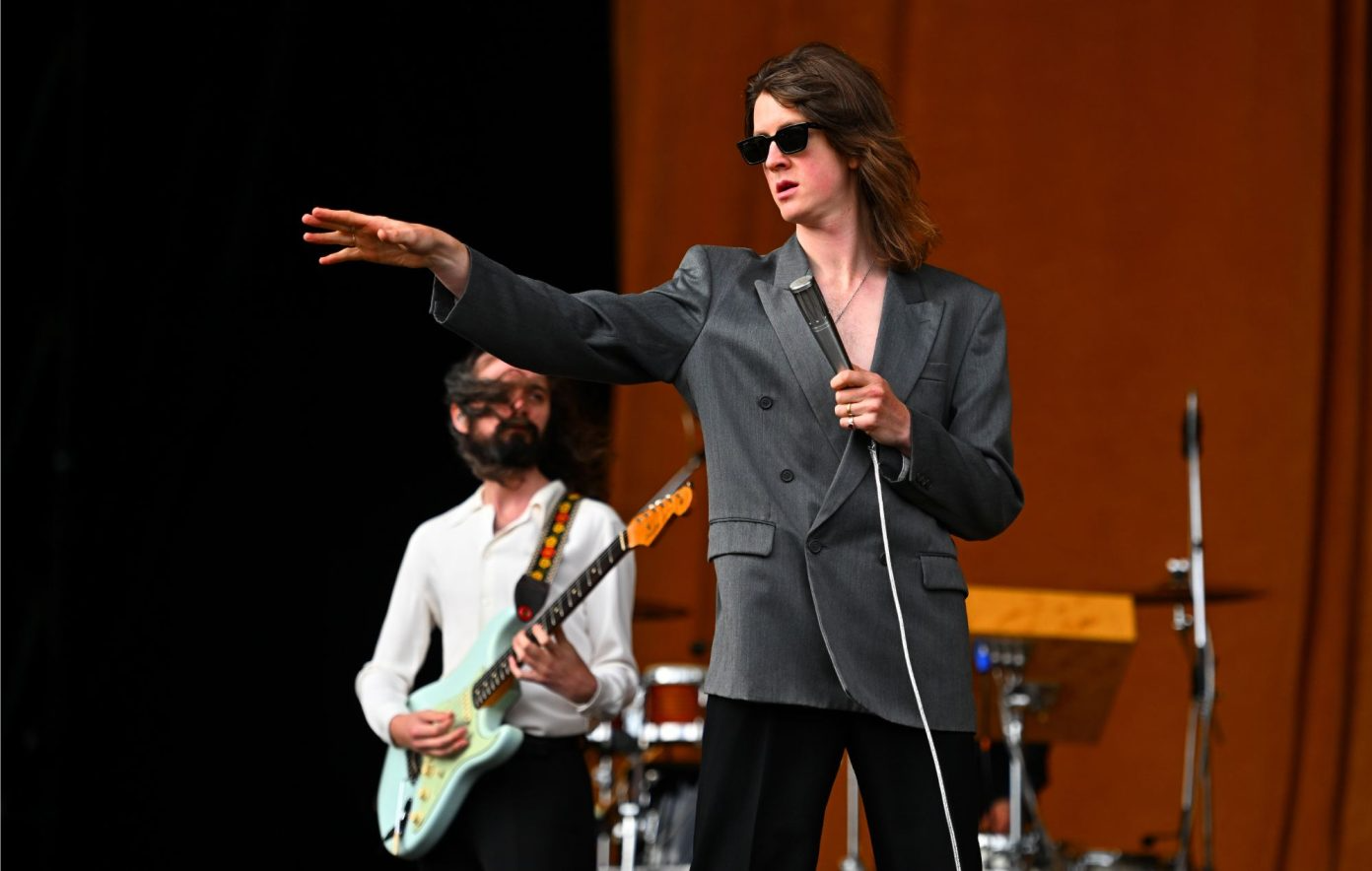
Blossoms caught up with NME to discuss competing with The Beatles and Johnny Marr for this week’s Number One album. With ‘Songs From The Wedding Cake’ in the running, the band also explained why making things themselves remains such an important part of their work as AI becomes more common.
The Stockport group put out their sixth album last Friday, October 2. By the midweek update, it was sitting at Number Two, between The Beatles’ expanded edition of ‘Rubber Soul’ and Johnny Marr’s latest solo album, ‘The Age Of Everything’.
“It’s mad, to be honest,” singer Tom Ogden said to NME about the chart race. “Liverpool on one side, Manchester on the other and Stockport in the middle. If you’d told us this 10 years ago, when we were releasing our debut, I wouldn’t have believed you. But I mean, we’re in good company aren’t we?”
Discussing the stories behind the album, Ogden described ‘Songs From The Wedding Cake’ as “about being married and all the everyday stuff that comes with it”. He married Katie Donovan, the sister of Blossoms drummer Joe, in 2021. Married life has since given him a new appreciation for what he describes as “the extraordinary ordinary”.
“Saying the wrong thing in an argument, losing your wife’s no claims bonus, crying at the Kardashians, it’s all in there,” he explained. “The album is named after Stockport Town Hall, which everyone round where we live calls the Wedding Cake, and it’s where I got married, so it couldn’t be much closer to home.
“The last album [‘Gary’, 2024] had a song about a stolen fibreglass gorilla, which everyone loved, and that gave us the confidence to bring the same playfulness to this one, just with more personal subject matter this time.”
Alongside tracks that came out of writing sessions with Declan McKenna in a hot tub, the album reflects the band’s desire to stay involved in every part of the creative process.
“It started with the recording,” Ogden explained. “We made the album with Shawn Lee, playing live straight to tape, and once you’ve done it that way you can’t really go and fake everything else. We sat down as a band and picked the colour palette, and everything visual followed from that. We had body scans taken of ourselves and cake toppers of the five of us 3D printed, put them on a real cake and photographed it. I’ve directed and edited the videos, and the sets are all built by hand, no green screen. For the pop-up shop on launch weekend, a local artist hand-painted the album cover for the sign outside.
“It’s more work, but you end up with a world that’s yours, and I think people can tell when a band’s had its hands on everything.”
With AI tools and digital effects becoming increasingly widespread, that approach feels particularly relevant. For Blossoms, though, the motivation is simple: “the fun is in the making”.
“Tape doesn’t let you cheat and neither does a real cake,” Ogden said. “If a set’s a bit wonky, it’s because one of us or our mates built it. I think the more stuff gets generated, the more people want to know a human being actually did it. We’ve been in this band together for over 10 years, five lads from Stockport, and that isn’t something you can ‘prompt’.”
Maya Jama also appeared in the video for the album’s first single, ‘Meet Me In Love’. Her appearance came shortly before the UK launch of Celebrity Traitors, where she took on the role of a traitor alongside a cast that included Richard E Grant and James Acaster.
“She was brilliant,” Ogden recalled of working with Jama. “We’d met her at the MTV EMAs in Manchester a couple of years ago, so we took a chance and sent her a DM …and she said yes. Next thing she’s in a theatre in Cheadle miming my vocals while a load of people dressed as me serenade her. She got the idea straight away and was a proper laugh about it.”
The conversation then turned to whether he thought Jama could take home the win on Celebrity Traitors.
Ogden joked: “As for Traitors, she spent a whole day pretending to sing my song and I almost believed her, so I’d say she’s got every chance.”
Fans can listen to ‘Songs From The Wedding Cake’ now. In November, Blossoms head out on a UK arena tour with The Royston Club. Tickets and further details are available here.
Before the tour begins, the group is also scheduled to appear on SNL UK on Saturday, October 24.