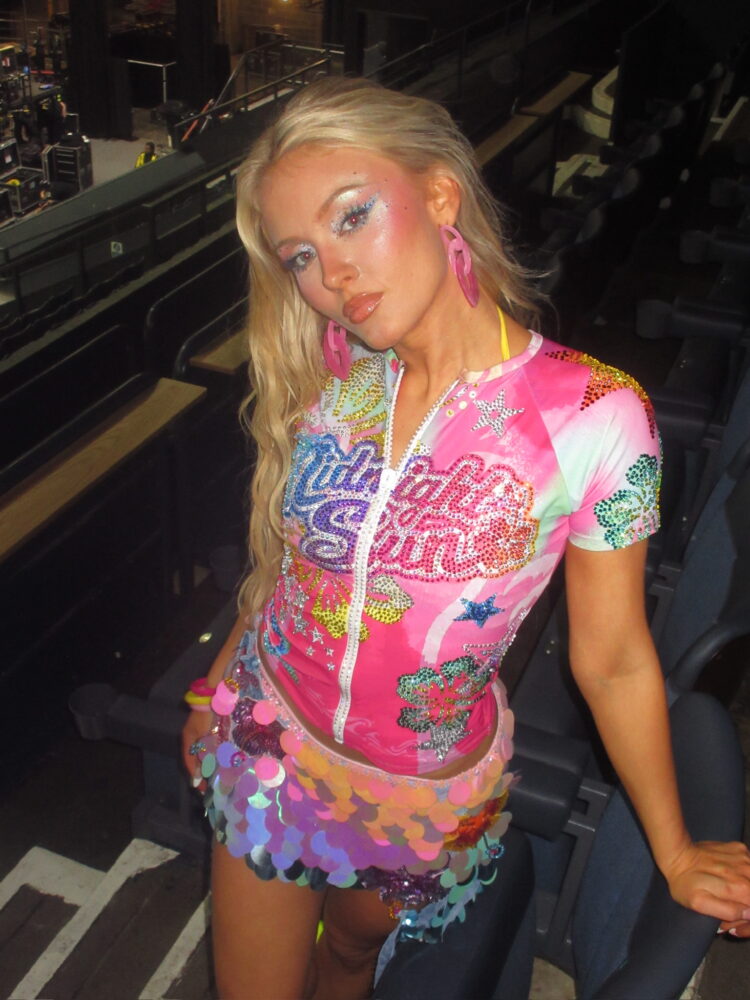
By the time Zara Larsson and PinkPantheress finally connected over Zoom last week, Larsson playfully said, “This is our first date, actually,” even though the two had already been moving in the same pop universe for a while. One is a Swedish artist with a love for big sounds and bold style, often jokingly called “Beyonce’s daughter” by her fans, complete with a dolphin inspired wardrobe and a Grammy speech already mentally prepared. The other is a self described “control freak” known for her bangs, jungle influenced production, and sharp awareness of how music lives online. When the Grammy’s arrive in February, they will both be competing for Best Dance Pop Recording, with Larsson nominated for “Midnight Sun,” the shimmering standout from her September album, and PinkPantheress nominated for “Illegal,” the Tik Tok driven third single from her album Fancy That. In October, the two released their remix of Pink’s hit “Stateside” even though they had never met in person, which made us decide it was finally time to bring them face to face. So the morning after learning they had each earned their first Grammy nomination, they sat down together for a true pop girl meeting. —OLAMIDE OYENUSI
ZARA LARSSON: Hey, queen.
PINKPANTHERESS: Hi, nice to meet you. I’m just driving home.
LARSSON: Isn’t this crazy? I’m like, I have not even actually directly spoken to this girl. This is our first date, actually.
PINKPANTHERESS: Exactly.
LARSSON: Oh my god, congratulations on your Grammy noms.
PINKPANTHERESS: Thank you so much.
LARSSON: It’s fucking crazy. That’s your first nomination, right?
PINKPANTHERESS: Yeah, it’s my first nomination. I woke up and I was like, “There’s no way this is real.” I’m being so serious. I thought it would never happen. But well done to you as well.
LARSSON: Thank you. How was your tour? It looked so fun. I saw someone give you a chicken.
PINKPANTHERESS: Someone gave me a rotisserie chicken. [Laughs] It’s been really good. I’ve got my last show in L.A. today, then I’ve got two more, and then we’re done. I’m just ready to just be able to spend the rest of this year just kind of on holiday. How long is the rest of your tour?
LARSSON: We’re halfway, which is crazy. I mean, we’re only doing 17 dates. I went straight from the Tate [McRae] tour, which was 31 dates, and then into this, and then we’re doing some radio stuff.
PINKPANTHERESS: 31?
LARSSON: Yeah, and that was only a small fraction of her tour, because she’s been doing this tour for a year. You remember reading in magazines and stuff back in the day where it was like, “These divas demand this backstage and they want this toilet paper.” And I’m like, “Yeah, duh, because it’s literally your home for the next year.” [Laughs] I can’t wait until I’m on that level, where I get to have my special toilet paper. I’m excited about that.
PINKPANTHERESS:[Laughs] I’m pretty sure you could ask for that right now. Like, immediately.
LARSSON: [Laughs] You know what? My rider is so fucking trash that I always go in and steal the snacks from my dancers. And my tour manager’s like, “You know you can just ask to have stuff on your rider?” I’m like, “No, no, it’s fine. Don’t worry about little me.”
PINKPANTHERESS: I don’t know if it’s because we’re European—or you are, since I’m out of the EU now—but I think it’s something to do with how we’re always too scared or shy to ask for anything.
LARSSON: I don’t want to be a problem.
PINKPANTHERESS: Yeah, you don’t want to be a problem.
LARSSON: That’s part of what it means to be Swedish.
PINKPANTHERESS: I really want to go to Sweden. Oh wait, I’ve been to Sweden, actually. [Laughs] I forget where, but I’ve been there. I was going to ask though, since you mentioned it—you opened for Tate. I’ve been an opener, and it was a great experience for me. But was there anything you were worried about?
LARSSON: Well, I’ve opened for lots of people before, honestly. So when I did the Tate thing, a part of me was like, “I have to be an opener again?” I thought, “At this point, I just want to not be an opener.” But I’ve done it for Clean Bandit, I’ve opened for Ed Sheeran, I’ve opened for Kygo, but no one’s really matched my vibe and the audience the way that Tate has. If you buy a ticket for Tate, I think you’ll appreciate my show. I was thankful for the opportunity, but I was also really excited for this to be the last time I’m going on tour as an opener. But what were you worried about before opening?
PINKPANTHERESS: Well, at the time that I did it, sometimes I felt like I didn’t deserve it. It was an arena tour, so I felt like I wasn’t equipped. I’ve only just about figured out how my body can move this year. I wasn’t at one with my body. I was also not a confident singer at that point.
LARSSON: Can you remind me who it was for?
PINKPANTHERESS: It was for Olivia Rodrigo.
LARSSON: Oh, right.
PINKPANTHERESS: She’s mother. An incredible artist. I did my best. But I will 100% say that I think only this year have I actually figured out how to really approach my life. And once I figured it out, everything fell into place.
LARSSON: No, I see that. You look like you’re having so much fun.
PINKPANTHERESS: Thank you.
LARSSON: But I also have to tell you that I feel like we’re super different in the way we’ve approached our careers. You’re really, really true to yourself—you do things that are true to who you are, and you do them your way. And that’s why even if you would have been standing completely still with your handbag on stage, that was also your thing—and people appreciated that being your thing. So I think it’s a win-win. People love to see you grow, but they also love you for you.
PINKPANTHERESS: Do you feel like you weren’t being super authentic at one point?
LARSSON: It’s not that I wasn’t being authentic, but I feel like I didn’t have control over my artistry because I started off so young. It’s funny ‘cause you’re like, “I never thought I would be nominated for a Grammy.” Girl, listen—I have practiced my Grammy speech since I was eight. [Laughs] This to me is like, finally. Because I’ve had this dream, which I think was more about wanting to be seen and wanting to be loved—which is a whole conversation in itself. I love to perform. In a way, when I started out, the music itself was secondary. So it took me until, honestly, this album to be like, “No, no, no. I’m going to make this with my friends. I’m going to do this with people that I love and trust, who see me and make me feel confident.”
I also think I’ve now realized that, growing up, I mostly cared about women who could sing. I just wanted to hear “Rah rah rah.” I wanted to listen to Celine [Dion], Christina [Aguilera], Beyonce, fucking Aretha Franklin. I just closed my eyes and pretended to be that. And singing—the using of my voice— has been my passion. But the older I get, I realize that you can be an amazing artist and not a fantastic vocal performer, and you can be an amazing vocalist and not a very good artist. I want to be an artist. I don’t just want to be a good singer, because then I can go and sing on a cruise ship. Nothing wrong with that. And I think that’s why people love what you do, because you feel you have your world. So how did that come about for you? When did you go, “I’m going to wear tartan. I’m going to have my bangs. This is me.”
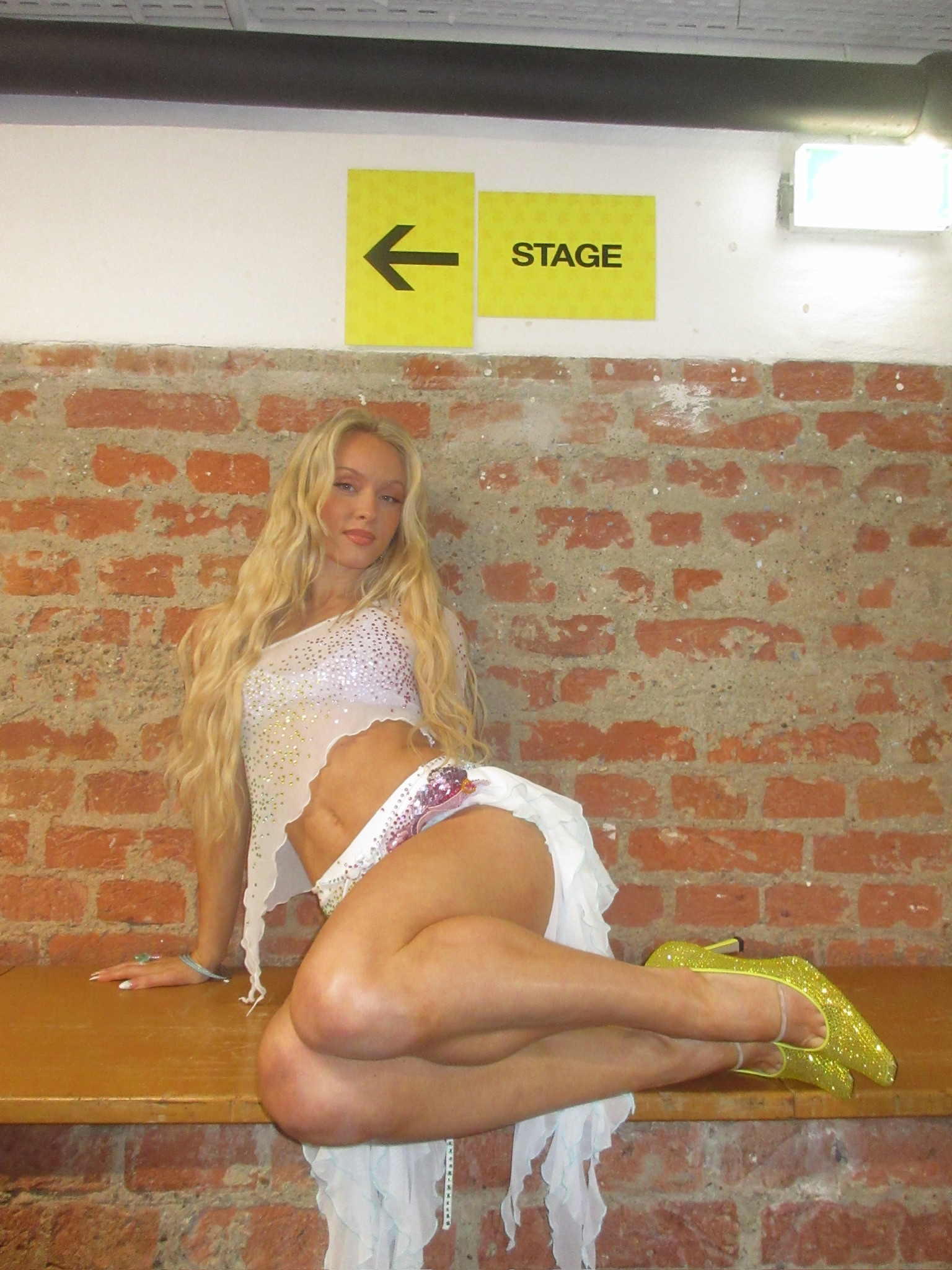
PINKPANTHERESS: So for me, I didn’t always have an aesthetic. I’ve just always been myself. But I definitely didn’t think of anything branding-wise until I met Ice Spice, honestly.
LARSSON: Interesting.
PINKPANTHERESS: When I saw her and I saw how she was so recognizable, how she had it figured out, I was like, “You know what? I want to brand myself. I want to have a look that people would know me by.” But I also wanted to feel more confident in how I looked. That’s when I got the bangs. I have a big forehead, so I was like—
LARSSON: [Laughs] It suits you so well.
PINKPANTHERESS: Thank you.
LARSSON: It’s also K-pop. I know you’re a big K-pop fan.
PINKPANTHERESS: I am indeed, girl. But I agree with what you were saying about being a real artist. I always say to my friends, “I love this person and what they do, but they don’t feel like an artist to me.” I think everyone has their own power in what they do, but when I listen to “Midnight Sun,” when I listen to the album, I feel like I’m listening to you and I’m visualizing your moves—your dance moves that I’ve been seeing, your outfits.
LARSSON: Thank you.
PINKPANTHERESS: Everything for you recently has just come together. And I think that we’ve been waiting for someone like you to come in—someone whose vocal ability matches the dancing ability, someone who matches everything.
LARSSON: Oh, that’s so nice. I feel like I’ve almost had plenty of one-hit wonders, in a way. And now I’m like, “No, I want people to know me and what I like.” At your concerts, people get to step into your world. And for me, for the first time now, I can see the girls with the flowers in their hair, they have the chain belts, they have the sparkly tops. And I’m like, “Fuck yeah. You get to be a part of this world.” And isn’t that amazing to see—when you’re on stage and everyone’s dressed on theme like we’re going to the same party?
PINKPANTHERESS: I always think about that. I always think about a uniform. And you’ve touched on something in terms of aesthetic that I don’t think anyone really has. That’s such a power in itself. It’s so interesting though, because as a British person, I’ve literally known about you for years and fucking years, girl. I always knew you from being hilarious. But then also, the time that you came up in, I think pop music has changed so incredibly. Back then I feel like female vocalists were essentially just that. Especially if you were European, female vocalists were basically just a vessel for a producer to have a hit.
LARSSON: It’s like, we’re used as an instrument in the production.
PINKPANTHERESS: But obviously, we know Zara Larsson as an entity. We know her as a voice. We know how she looks. I feel like producers back then were like, “Okay, this is the Clean Bandit song.” But it’s like, okay, we’re all singing Zara Larsson.
LARSSON: In a way I’m now like, “Okay guys, everything before this was just rehearsal. Now is when it starts for real.”
PINKPANTHERESS: That’s incredible.
LARSSON: Did I make this up, or did I read this somewhere? That you wanted to be anonymous in the beginning.
PINKPANTHERESS: Oh yeah, I was anonymous. But after a few TikTok songs had gone, I was like, “Okay, I’m done. I really want to make sure that people know me.” But I think that I hadn’t necessarily figured out how to just translate myself very well yet. I’m from the U.K. There’s not many jungle artists in general, or drum and bass, two-step, in the genre that I do. I would love to be a representative of the kind of music I make, and also how I look.
LARSSON: And you have such a specific sound, I think. People are like, “This is a PinkPantheress song.” That’s one of the hardest things, and you really found it.
PINKPANTHERESS: Thank you.
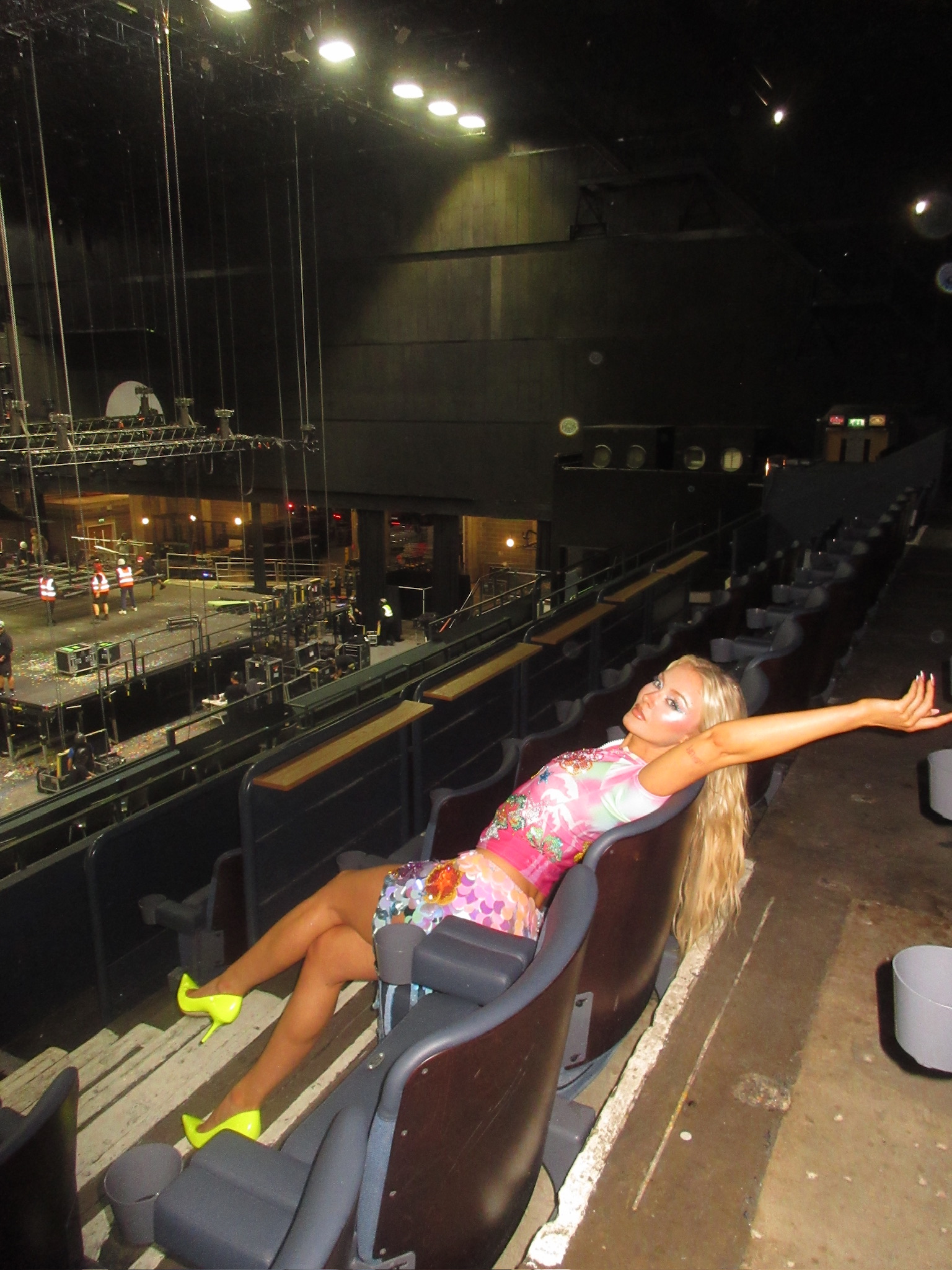
LARSSON: Would you say you’re a bit of a control freak?
PINKPANTHERESS: Yes, I’m definitely a control freak. But I’m open to collaborating.
LARSSON: Yeah, I guess it’s because you care. I mean, this is the first album where I’ve written all the songs. When I started out, I didn’t write anything. All I knew was, “Give me the mic. Where’s the stage? I just want to perform.” And now I feel like we’re almost meeting each other halfway—you started out as a musician turning into a performer, and I started out as a performer turning into a creator. Because that’s been a dream of mine: to be able to at least start an idea by myself. You don’t even know how many times I’ve opened Logic or whatever and I’m like, “What the fuck?” There’s just so many things to do. Then when I do something, it’s just like, “Bleep, bloop, bleep, bloop, bleep, bloop. Where did you start producing? And get to a point where you felt like, “Oh, this is fire.”
PINKPANTHERESS: I feel like I’m very internet-era. So for me, it was essentially TikTok. [Laughs] Every time I’d be like, “I don’t know if this is eating or not,” I would post it online and see what people’s reactions were.
LARSSON: So you would give the people a little taste test, essentially?
PINKPANTHERESS: Yes. I enjoyed teasing it.
LARSSON: That’s so smart.
PINKPANTHERESS: But I always think about how, if I came up in a different time, maybe earlier than TikTok times, you would have to rely on charting. It’s crazy that there was ever a point where the internet didn’t really play a huge part in how well a song did. You’re literally just relying on radio to pick it up.
LARSSON: Totally. It’s just so incredible to me that you’ve connected directly with the audience. It’s like, “Okay, where are we going, guys?” And without having this middleman kind of deciding for either side. And you do that from your bedroom, essentially. Because maybe back in the day, you needed to tour to promote an album. Nowadays, people promote their album so they can tour, and you can reach so many people from wherever you are.
PINKPANTHERESS: You know what’s crazy? Even now, on my Twitter, I can’t scroll without seeing you, girl. And I always stay watching it. I will not scroll past. And I’m like, “Okay, get in there. She’s hitting her shit.”
LARSSON: [Laughs] I can’t be on Twitter.
PINKPANTHERESS: They love you, though. No negative comments made, girl.
LARSSON: Yet. [Laughs]
PINKPANTHERESS: I get that. It’s always a “yet.”
LARSSON: It goes up and down. I could sit up until 6:00 AM just reading tweets, my heart racing. I don’t know what chemicals my brain is sending out, but it’s like a fucking drug.
PINKPANTHERESS: Yes.
LARSSON: But now I know that even if it’s good or bad, it doesn’t really really matter, you know what I mean? I really appreciate it, but that’s not the reason why I do it.
PINKPANTHERESS: Yeah, I get that.
LARSSON: I’m just super happy. But also, I want people to connect with my music. If I do say something about politics, maybe they’re like, “Oh, let me look that up.” Even being pro-Palestine or going to demonstrations, speaking up about whatever it is, that’s just who I am as a person. But the praise that I’m getting now is kind of crazy to me, because I’ve never had this much positive love thrown at me. And I know that I’d be addicted to that. But I also deleted Twitter because people flip-flop, and I’m actually more scared of the day where somebody decides that they don’t like me, that it would hurt me so bad that I couldn’t handle it.
PINKPANTHERESS: And you’re from Sweden, so it’s kind of harder to break through in a way where Americans are listening to you, for multiple reasons. It’s a lot harder to get a face attached to the name as well.
LARSSON: The American propaganda machine worked on me, because I’ve always had a dream of coming to America.
PINKPANTHERESS: The American dream.
LARSSON: [Laughs] The American dream, yes. In general, Sweden is very minimalist. It’s not flashy, it’s not colorful. Maybe I’ve been trying to hide my style a bit, because I’ve always loved pink, neon, glitter, sparkle. And then that fucking dolphin meme came around and I was like, “That’s literally me. This is where I want to live.”
PINKPANTHERESS: And to a degree, there’s a truth in that. In America, there’s money. And when you have more money, you get more budget, and you can fulfill the artistic dream. I feel like in America, I’ve got a pretty decent standing. But the U.K. is the place that I’ve always wanted to get the respect.
LARSSON: Right.
PINKPANTHERESS: Because I feel like my music is very British. I’m obviously British, and I’ve always thought to myself, “Damn, I hope one day I can be a really big, big British artist.” But funnily enough, I’m not huge in the U.K.
LARSSON: That’s so interesting. You’re so big here in America.
PINKPANTHERESS: I will say that I feel like a lot of my artistry challenges what American music sounds like. I think it’s good because it makes me stand out, but I do think that the U.K. has always been the thing. I just have one more question, because I watch your clips a lot. Do you ever get stage fright, or panic and have to run off stage?
LARSSON: The only time I feel really uncomfortable is when I have to talk. I hate when I have to speak on stage, which is very ironic, because I love to talk. But there’s something about speaking on stage that has always been my—ugh. I just feel way more confident and comfortable singing a song, because I know how to do that.
PINKPANTHERESS: Totally. I’ve got a funny story about when I smoked weed and—
LARSSON: Oh, hell no.
PINKPANTHERESS: [Laughs] I did it hours before a performance and I was on stage and I just started spinning. I was like, “Oh my god, this cannot be real right now.” Obviously, I had to do my due diligence and kind of figure it out, and it was genuinely one of the worst experiences of my life. That, for me, was the catalyst for my stage fright.
LARSSON: Stage fright, yeah, I hate that.
PINKPANTHERESS: Are you sober?
LARSSON: On stage, no, I don’t drink. We do take hella edibles, and I must say, I would never perform if I wasn’t sober. I know in the industry some people have a few beers before they go up and play, or they smoke a lot. On the Tate tour, I must say there were maybe two shows where I was stupid high off of edibles and I had the best time ever. And I was actually a bit nervous before because I was like “Fuck, I’m actually high.” In general, I just like to be in control when I’m on stage.
PINKPANTHERESS: Yes.
LARSSON: I’m excited to see you live. I’m going to catch you somewhere.
PINKPANTHERESS: Girl, actually, are you coming to Coachella? Or doing it?
LARSSON: I’m coming. Oh my god. You’re performing? Oh, I’m coming.
PINKPANTHERESS: My manager was already like, “No, we need to get Zara to come out.” I was like, “Yes.”
LARSSON: That would be sick. Coachella is my Christmas. And honestly, we’ll meet each other at the Grammys. How fun is that?
PINKPANTHERESS: Oh my god, I can’t wait to see what you wear, girl.
LARSSON: I think we both want to win really badly, but if it’s not me, I really want it to be you.
PINKPANTHERESS: I mean, there’s another Grammy that I’m up for, which is the album, and that’s the one that I would love.
LARSSON: Of course.
PINKPANTHERESS: But the dance-pop record, I actually genuinely don’t want my song to win. I want “Midnight Sun,” because that song is just so much more interesting than my song. It’s such progressive pop. It’s just really, really good.
LARSSON: I feel like it’s going to be such a fun year for us—2026.
PINKPANTHERESS: I hope so, girl.