LIVE REVIEWS
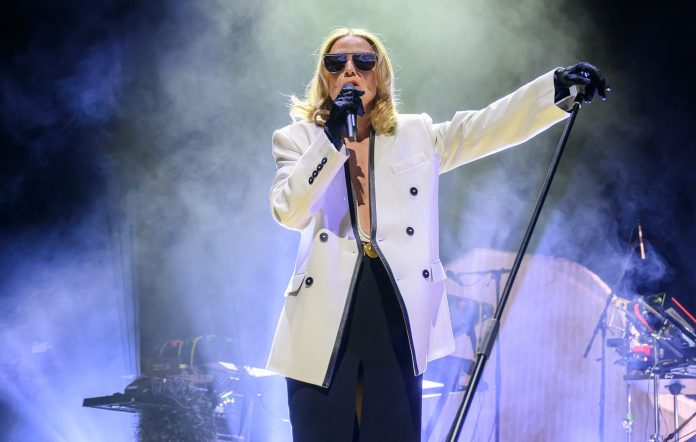
In a top hat, framed in black and white, Róisín Murphy stares down the lens. Facing away from the audience, she peers into a camera on a mount; the resulting image is beamed via an imposing screen at the back of the stage. With the 10,000-strong Alexandra Palace crowd behind her, she scarcely blinks as an insistent house beat burbles away.
She slips off her jacket, runs both hands down her neck, her five-piece band churning confidently through the lithe funk of ‘Can’t Replicate’. When the beat quickens, she flexes her muscles and poses like a prize fighter with arms aloft. “I need you,” the 50-year-old croons steadily, shadowboxing on the spot, never breaking eye contact, “so you don’t you keep it… I love you.”
It’s a message, perhaps, for the fans who’ve stayed with her on the rocky road to this undeniably impressive show, her biggest yet and a milestone in any artist’s career. Murphy takes a few songs to warm up, but when she does, the rewards are bountiful, as she complements her experimental dance-pop with an array of outlandish costume changes. Once she’s paired the knockabout ‘Ramalama (Bang Bang)’ with an oversized feathered headdress and the stoic ‘Something More’ with a funereal black veil, you’re well-reminded she’s been donning daft gear since Harry Styles was in his school uniform.
Six months have passed since the release of the former Moloko singer’s thrillingly weird, Balearic-flavoured sixth solo album ‘Hit Parade’. Murphy had long been a critical darling, but this record, which ebbs with a potent, insular magic, appeared destined to bring her to a whole new stratosphere of acclaim. Just over a week before it came out, though, she went viral for all the wrong reasons.
It emerged that, on her private Facebook page, the queer icon had described the use of puberty blockers in young trans people as “fucked, absolutely desolate, big pharma laughing all the way to the bank”. The screengrabbed comments duly blew up on Twitter, appalling vast swathes of her audience. Her label, Ninja Tune, reportedly ceased to market the album, an apology was issued, gigs were pulled and Róisín Murphy was quite literally cancelled.
The furore marked one of the stranger and more unexpected chapters in the culture wars. In fact, it seemed the only thing anyone could agree on was that ‘Hit Parade’ is an extraordinary album – one that became her biggest commercial success so far, reaching Number Five in the UK. And then this enormous show sold out back in December.
If the ensuing crowd is best described as “40-something and intense-looking” (there must be at least 5,000 pairs of thick-rimmed spectacles on display here), the music itself is, for the most part, transcendently light-hearted. Murphy dances cartoonishly to the crunching disco of ‘Incapable’, stopping just short of jazz hands, and grips the mic stand when she head-bangs to her ‘00s anthem ‘Overpowered’.
She says little, beyond repeated expressions of gratitude to the audience, but spends the encore doing press-ups in a floor-length sequinned gown; an image that seems to speak volumes about her determination to keep this show on the road. On tonight’s evidence, you wouldn’t bet against her.
Róisín Murphy played:
‘Pure Pleasure Seeker’
‘Dear Miami’
‘Simulation’
‘Overpowered’
‘CooCool’
‘The Universe’
‘You Knew’
‘The Time is Now’
‘Incapable’
‘Something More / Let Me Know’
‘Sing It Back / Murphy’s Law’
‘Can’t Replicate’
‘Ramalama (Bang Bang)’
‘Forever More’
LIVE REVIEWS

Slayyyter played her take on Turnstile’s ‘Birds’ onstage for the first time in Atlanta. You can watch footage of the performance below.
Slayyyter is currently touring with her ‘Wor$t Girl In The World’ show. She added the cover to her set at The Eastern on Monday night (September 21).
She sang ‘Birds: Slayyyter Version’ near the end of the main set, following ‘Brittany Murphy’. She then came back for an encore featuring ‘Brand New Chanel$’ and ‘Beat Up Chanel$’.
It was her first live performance of the song. She originally recorded it for Turnstile’s ‘Never Enough: Versions’, a collection of reworked tracks released on August 28.
The 22 track release brings together new interpretations of songs from Turnstile’s fourth album. Contributors include Elton John, Hayley Williams, Blood Orange, A. G. Cook, Faye Webster, Four Tet, Oklou, Floating Points, Nourished By Time, Alex G, Julien Baker and Mustafa.
Panda Bear recorded a new take on ‘Magic Man’, while Dying Fetus gave ‘Birds’ another interpretation rooted in death metal.
See Slayyyter perform the track live and listen to her studio recording here:
Slayyyter trades the original song’s hardcore intensity for a bigger electronic sound that feels at home alongside her latest album, ‘Wor$t Girl In America’.
Turnstile first released ‘Birds’ on their 2025 album ‘Never Enough’. The song won Best Metal Performance at the 2026 Grammy Awards, where the album also won Best Rock Album.
In its five star review of ‘Never Enough’, NME pointed to ‘Birds’ and ‘Sole’ as reminders of Turnstile’s hardcore beginnings. It also praised the album for “furthering their unique, pop-facing take on hardcore”.
Slayyyter will join Turnstile on another stage next month. She and Die Spitz are set to support the band at the University of Kansas in Lawrence on October 6 for the ‘Never Enough Tour Pt. 2’.
It has been a big year for Slayyyter. Her third album, ‘Wor$t Girl In America’, came out in March, and NME’s review highlighted its mix of “brash, sleazy pop” and late 2000s indie sleaze sounds.
Last month, she performed Hole’s ‘Violet’ for triple J’s Like A Version. Courtney Love called the cover “a delight” and encouraged Slayyyter to “keep wiping the floors with us”.
A few weeks later, Slayyyter took ‘Wor$t Girl In America’ to Reading Festival. NME’s live review declared that there was “undoubtedly a star before us on stage” and praised her “rasped, rocked-up delivery” and growing confidence as a performer.