
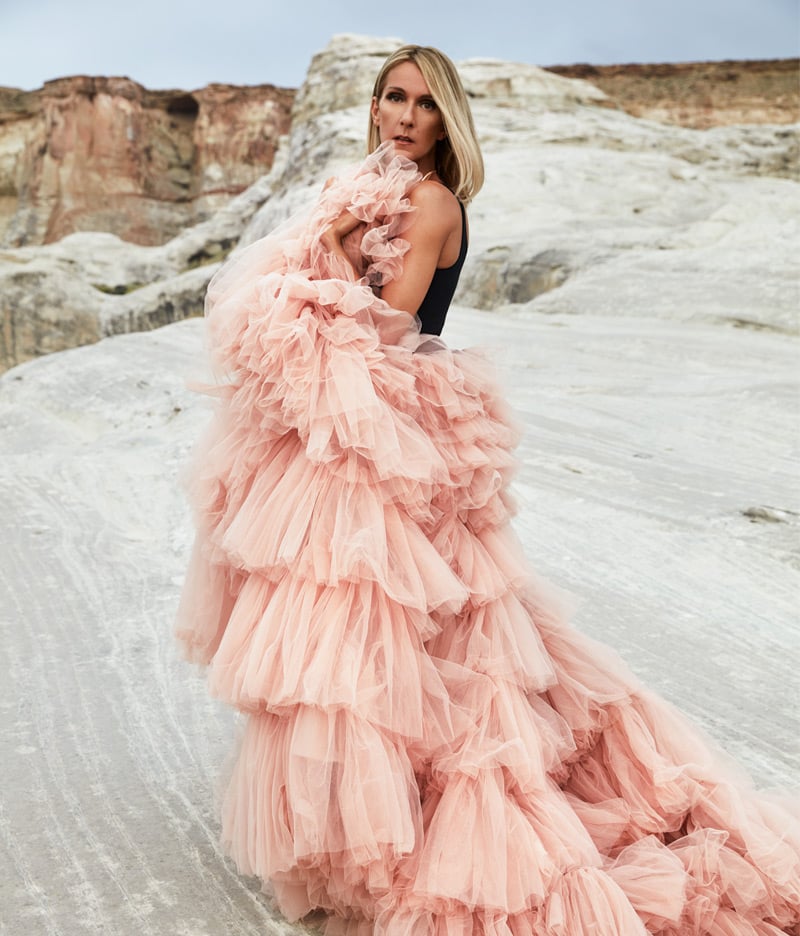
Celine is one of the most beloved performers in the world. Having broken attendance records with her Vegas shows, she’s also created a wardrobe of successful fragrances over the past decade. She sat down with Dave in New York for a candid discussion about perfume, family and beauty.
Dave: What’s the best thing about being famous?
Celine: The best thing about being famous is I arrived last night in New York City and asked for eight tickets to Lion King tonight for my son to go and see the show and it was possible.
Dave: What’s the worst thing about being famous?
Celine: I asked for eight tickets to go see the Lion King and I can’t go because I’m busy (laughs), No, I don’t know. It depends how you see things, you know. It can be that everything I might say for the worst thing can be nothing for some people. For example, for many people to be a little a sick and to be home isn’t a big deal. But those people may not have a job that you have to use a vocal instrument. For me to get congested or feel sick is very dramatic. When my sinuses and my throat and my lungs are not well, it becomes dramatic. I wish I could become a guitar player. When my guitar strings are not there I can just change them.
I recently had a micro-plasma pneumonia and it is very hard to find. But it’s very easy to cure. As a singer you say you have bronchitis because it’s easier for people to understand. It’s not my style to cancel shows. It’s not fun to be sick, and it’s so hard to cancel a show. I still enjoy what I’m doing, and I know how much involvement it took for them to come. It’s a whole experience coming to one of my shows.
Dave: What are your first memories of scent?
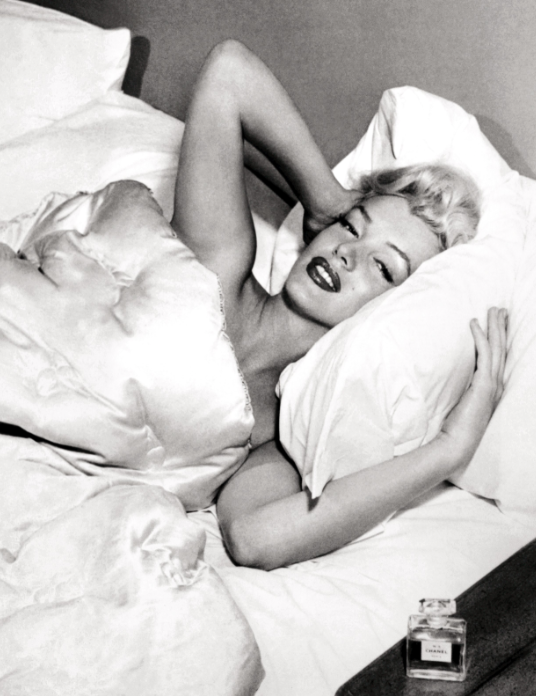
Celine: I remember buying for myself, Chanel No.5. Five has become over the years, and I don’t know why, my lucky number. And because it was perfume with the number five in it, Chanel No. 5, then it had to be my perfume. I was very interested, like everyone, in Marilyn Monroe. And I saw a picture once when I was a teenager of Marilyn Monroe in bed wearing Chanel No. 5 and I started practicing that every night. I was sitting in bed, spraying Chanel. And then when I started to have a crush and he was wearing Polo Ralph Lauren all of the time, I started spraying my pillow with it.
Dave: You’ve created many successful fragrances. What is it is about fragrance you find most interesting?
Celine: My dad has passed a number of years ago and it happens still today that I smell him. His smell: It comes out of nowhere so strongly. I don’t even know if it was the cologne of my dad but it his cologne or whatever he was wearing, his own smell mixed with that, his personality, it is very difficult to describe. Like the smell of child, it’s very hard to describe. My mom is also like that. She has her own smell: breath, saliva, sweat mixed with whatever perfume she wears. It is something very unique to her. I’m finding with time that, I wish to find my own signature scent. I know a few people who have been wearing the same perfume for years. You put their coat in the closet and their scarf smells of their scent, their coat smells of it. And if you go to their house, it smells of it. You think of them and you know how they smell. I find this so interesting. I wish one day I could find my own scent. Me, I’m still following fashion.
I think perfume is such a comfort zone. I love when my son comes home and he says, “Oh mom, I missed your smile and your smell.”
Dave: I read that you don’t wear fragrance when performing.
Celine: When I sing I don’t not wear perfume. For example, when the stage crew uses Purell and I put the microphone close to my nose, it’s too strong and I kind of gag. It does that to me. The alcohol comes out even if it’s very soft. They used to do these things to make me feel fancy – they’d clean the microphone in case there is lipstick or something on it, and they’ll clean it with a product that had like cinnamon in it or something and it was just too strong. Or, you know there are like 40 dancers on stage and they are all wearing their favourite smell, and I’ll be singing something like “Seduces Me.” I sit on a chair and they all come half-dressed near me, sweating, smelling their own thing, their own scent – it’s a great bouquet. But I just stand there and look and enjoy, but I can’t perform. It’s too overwhelming for my vocal chords. My nose inhales that strongly and then I can’t project
Dave: Is there a childlike appeal to beauty?
Celine: You know, my son was very interested in scent and beauty as a child. He would very often look in my drawer and smell things. I’m keeper and I try perfumes and beauty products. It’s fun, it’s fun! He’d go through my old makeup box and he’d say, “Can I paint your face mom?” The love for a mother for a child and a child for a mother is so amazing and so strong.
Dave: What do you treasure most?
Celine: My family, oh gosh, my mom. I can’t wait. We have a few celebrations for the holidays we always do a big party every year for my family. Believe it or not my mother, Therese, is cooking for all of us and we are almost 180. She wants to cook. And we have a golf course in Quebec. We have two 18-holes, so we are equipped with a room to fit everybody and we have a big kitchen in the back with a chef there during the year helps us, so my mom’s there and she helps them and she’ll say, “Ok, now it’s ready, don’t put that there, help me to do this.” She does half of it at her house before, so she’ll prepare the meat pies and put them in the freezer and all her sweet relish, like ketchup, homemade ketchup, she prepares it all in advance. And I told her, “You don’t’ you think this is a little much,” and she said, “No, this is my gift. And I want to do it. And we’re gonna have a holiday this year just the brothers and sisters, no companions, no children. Just the brothers and sisters at my mom’s place, and she’ll be cooking again, I guess. And we’ll have a gift-exchange between us.
Dave: It must be hard to be away from your family for so long when you tour.
Celine: I’m so used to it. I mean, I don’t want to be. And the hardest part is when I’m home and I don’t want to leave. But, my mom comes to visit quite a lot. And every time we go on vacation I bring her. So I don’t wait 3 months, or 6 months before seeing my mother. The rest of my family, some members work with me on tour so I see some of them, but of course I miss them. But, I started to travel and tour so young that I think I got used to that routine of seeing them every six months. So it became quite normal. And now every time I see them there is like three newborns. So we are 180 now, and we don’t invite like, friends of friends. It’s just brothers and sisters and children, I think we’re up to like 36 nieces and nephews now.

Dave: Do you have your mother’s recipes?
Celine: We have plans for her to show me – I love to cook. I don’t get to do it, I mean, I don’t take the time because I don’t have the time, but it’s something that I do enjoy. I remember our first house in Florida, and I wasn’t very very busy and we moved it and I was doing it all, I was cleaning my house and I was cooking because I had time to do so and I so enjoyed every moment of it. In the morning leave the house like that, go play golf and then come in and figure out what we were going to have lunch and dinner and because I wasn’t used to that it became really relaxing to do so. Once it starts to become a routine, then it’s probably another deal. If you do too much of one thing it’s probably becomes a bore. For me to pack and to not be at home, it’s not that much fun.
Dave: Does the touring become for you?
Celine: Let’s say it becomes mental. I mean you have to physically and vocally concentrate, and discipline yourself. Once you do the same thing so much of the time it’s almost like you’re sitting in on it and someone else is doing it. You can’t just sit on adrenaline, you might be surprised that you forget your words and you forget a whole song. You have to be on the edge, sharp, all of the time. When I forget my words, I make them up and make them laugh and think, “Okay, here we go! 150,000 times later.”
Dave: What is your best beauty advice?
Celine: I want them to feel strong about themselves. A lot of people underestimate themselves. Not a lot of people say things like “Oh, you look good” or “thank you for helping me.” Every woman should feel she is important that she makes a difference and that she is loved. That’s success, you know, feeling good. And for those women that don’t get the chance to hear these things, I hope they find someone who they can relate to and feel strong. I want them to feel strong about who they are.
Elvis Presley – ‘Mystery Train’
“My first love was Elvis, no question. In our house, we had a French-release compilation album of his songs called ‘Le Roi Du Rock ‘n’ Roll’. As a small kid, I was obsessed with ‘Mystery Train’. The way Elvis held his guitar like a gun and the percussive way he attacked the strings made me fall in love with the guitar. Many years later, I went busking around Europe on my motorbike with a tent and played my guitar in the streets. But it was all because of Elvis and those early Sun [Records] recordings – and ‘Mystery Train’ in particular.”
Blondie – ‘Autoamerican’
“There was an Our Price on Finchley Road, North London that I’d go to with my older brother and sister. That’s where I bought ‘Autoamerican’ in 1981. Blondie – what can you say? Apart from the fact that as a young boy, it was impossible not to be in love with Debbie Harry. I love the variety on this particular record – it goes through different genres. Years later, I saw Blondie play [in 2013] at a private function in New York with Kanye West. Debbie Harry was still magnetic.”
Queen, Wembley Stadium, 1986
“Queen were supported by INXS. It was before they released ‘Kick’ [in 1987]. I only went because it turned out my friend Kieran’s dad was a big-shot in the music industry and he got four tickets. I was around 17, it was a year after they played Live Aid and Queen were phenomenal.”
The Beatles – ‘Eleanor Rigby’
“All through our early teenage years, my younger brother and I were always at the top of the house listening to The Beatles. ‘Eleanor Rigby’ reminds me of the ‘80s and the views out of our house in London: looking at the grey, rain-drizzled skies. I always felt its melancholy, looking out of the window back then as a teenager. Not that I was unhappy, but I definitely responded to that in music.”
Ever meet Macca?
“I have met Paul McCartney and he was a complete gentleman. At a political party, we were watching the American election on TV and he came up to me and said [Lewis does a pitch-perfect Macca impersonation]: ‘Oh, you understand a bit or two about the TV, don’t you?’. And I just realised he’d seen me on TV and I melted. I went to bed grinning. That McCartney knows who I am is incredible. I was completely tongue-tied.”
David Bowie – ‘Heroes’
“I know 173 other people will probably also have picked ‘Heroes’ for this, but from the opening note, it’s just relentlessly brilliant. It’s the most evocative, triumphant, euphoric song – and unbelievably cool. The second album I ever owned was Bowie’s ‘Hunky Dory’ – and he’s remained a touchstone for me.”
The Rolling Stones – ‘Little T&A’
“I listen to the Stones a lot and I can never get ‘Little T&A ‘ out of my head. Keith Richards is quoted as calling the song ‘dumb’ and that it’s just about rock ‘n’ roll energy. It’s a celebration of carnality, I’m aware of that, but that’s the one that stays in my head!”
Jive Bunny And The Mastermixers – ‘Swing the Mood’
“I can’t fucking hear Jive Bunny again! But I don’t mean that in a pejorative way. When I was in my twenties, I would go out on my own dancing to old-school rock ‘n’ roll at rockabilly nights. Then Jive Bunny came out and cut up my favourite songs into snippets and put them into this endless [novelty] medley. And then it was never off the radio, so I’d have to put it into the Room 101 of music.”
Crazy P – ‘There’s a Better Place’
“It’s an ambient rave tune with a fantastic Willy Wonka & The Chocolate Factory sample. I’m just that age. I left school right into the dance culture of the ‘90s and that will still always get me up on the floor.”
The Weepies – ‘Gotta Have You’
“It reminds me of moving to LA as a family with my late wife Helen [McCrory]. My daughter was one year old and my son was about to be born. We were living in Venice Canals – and I was filming out there. We had a babysitter who was a 23-year-old roller-skating, already-Botoxed sunny Californian girl. We asked her, are you listening to any good music? She gave us two great bands. One is The Shins but the other was a lesser-known band called The Weepies. That song will always get me going.”
Elton John – ‘Saturday Night’s Alright for Fighting’
“I can’t say I do karaoke but I will proudly divulge that I was at karaoke in Fulham Broadway once. I went in there with a friend and I got up and sang ‘Saturday Night’s Alright for Fighting’ and I won a bottle of champagne for best karaoke of the evening! Very chuffed I was too. If I was back looking for another bottle of champers, I’d pick it again.”
Talk Talk – ‘It’s My Life’
“I was an ‘80s kid and I liked electronic music. I’ve always loved ‘It’s My Life’ and Andy Hollis’ vocals, as well as its slightly bombastic nature. Life’s what you make of it – seems like a good sentiment to have.”
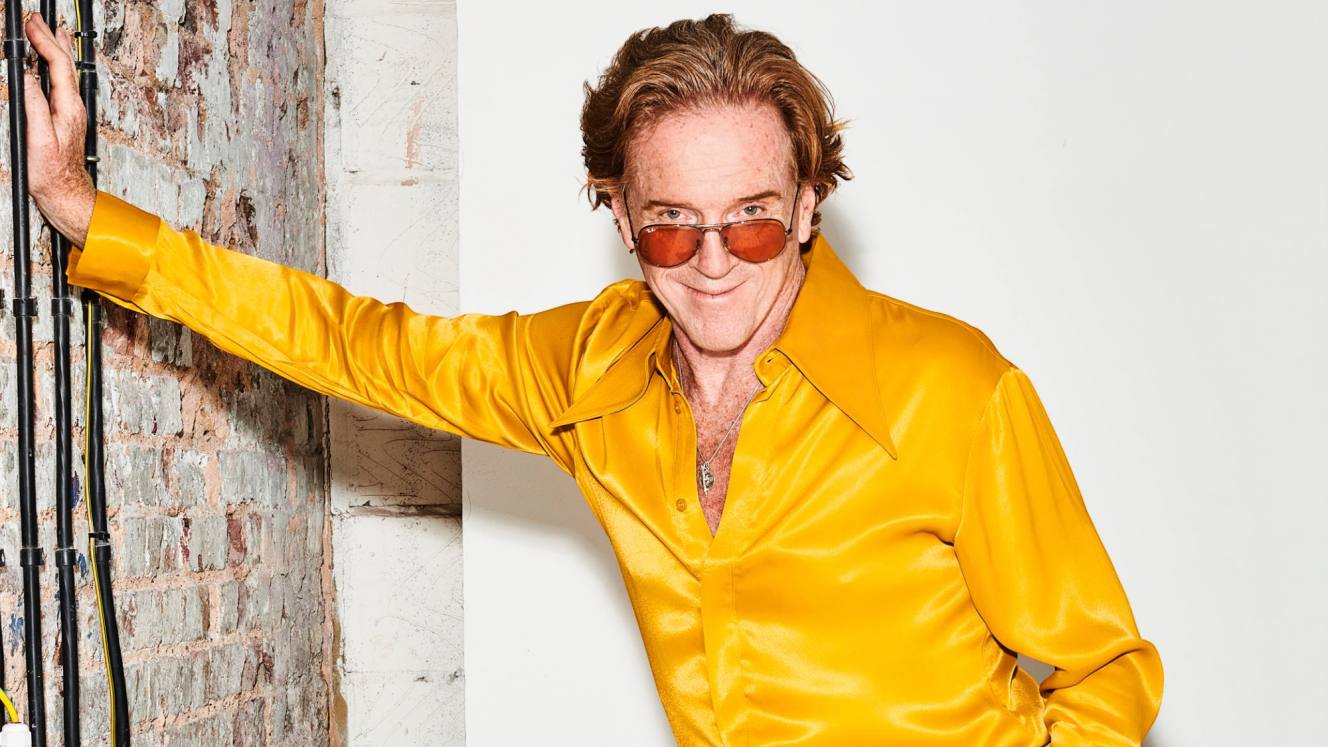
Damian Lewis’ UK tour begins on October 2. His album ‘Sweet Chaos’ is out now via Thin Red Duke