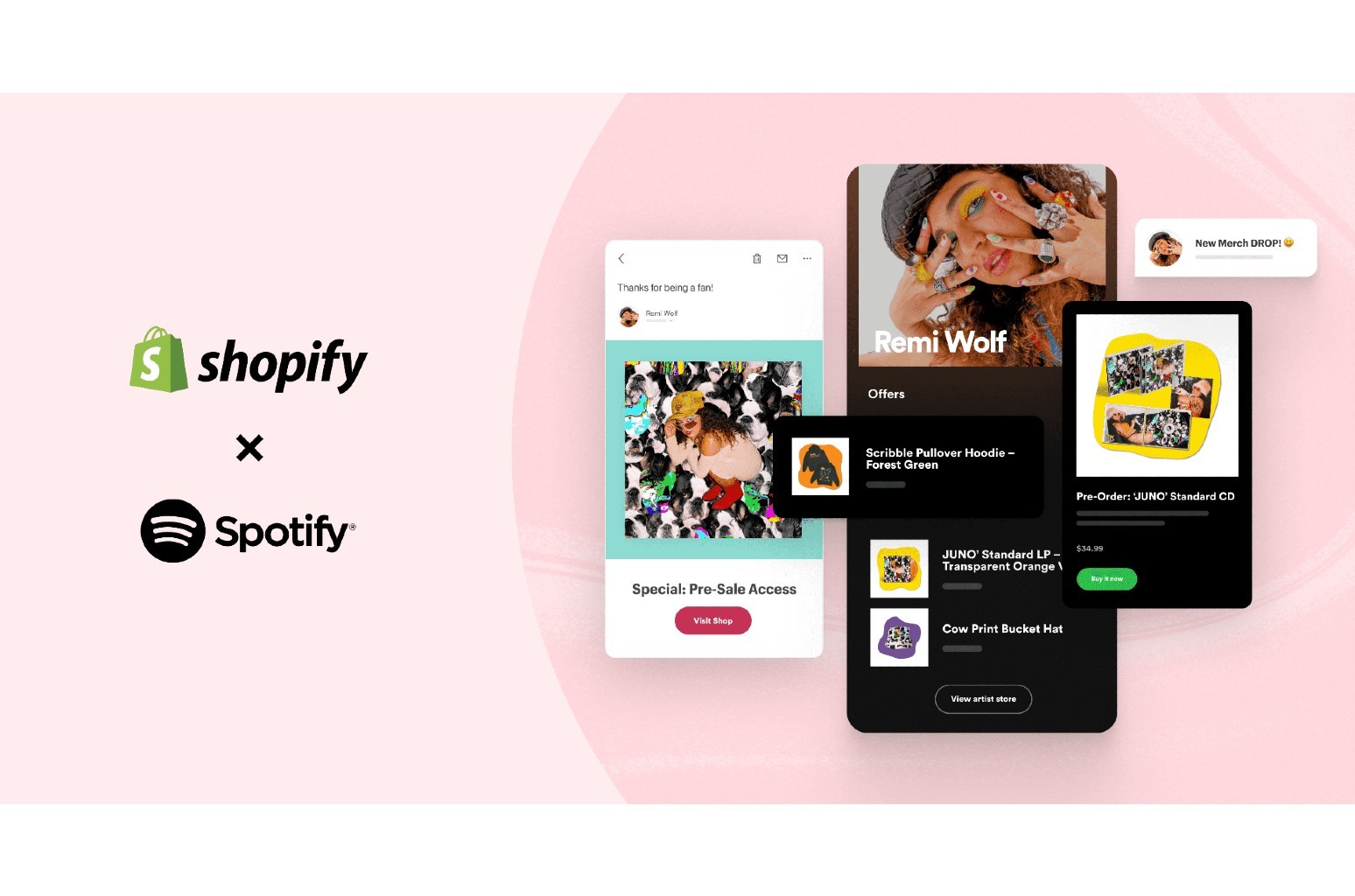
Spotify is partnering with e-commerce giant Shopify as part of a new beta integration launching Wednesday (Oct. 20) to allow artists to sell merchandise directly through the streaming service, the company tells Billboard.
The move will allow artists across the world to earn additional revenue from the streaming service, which has over 365 million monthly users in 178 markets.
This isn’t Spotify’s first foray into merchandising as the company has had a partnership with Merchbar since 2016, but adoption of that has been limited. Spotify says artists will be able to choose three items to display from their Shopify stores on their artist profiles.
In an interview with Billboard, Camille Hearst, the head of Spotify for Artists, said the goal for that program is to provide "the information and resources that artists need to grow their fan bases and ultimately get paid for them," and the Shopify partnership is the latest example of that. "As we think about what are all the ways we can help artists get paid, what are the ways we can help artists maximize additional revenue streams, merch is one of the things that comes top of mind," Hearst says. "That's why we are announcing this partnership with Shopify because we think it really is the next step in creating a holistic audience development platform."
"It's just a natural fit for Spotify in many ways," Hearst continues. "It’s exactly what artists will need to give them nimble control over their merch. It's really simple to decide what items are featured on an artist's page and it's easy to swap new merch in and out. Inventory management, any artist will tell you can be a pain. I've done a ton of interviews with artists where they talk about having piles of merch stacked in their living room, and Shopify eliminates all of that."
"Spotify is an important partnership for us because we see artists and creators as the next generation of entrepreneurs," says Shopify president Harley Finkelstein in a statement to Billboard. “Shopify has thousands of artists using our platform today to connect directly with their fans," Finkelstein continued. "Now, with our Spotify channel, we’re allowing artists to directly connect their online store with their Spotify artist profile so that they can sell products and engage with their fans where they listen, all while managing their businesses from a single platform. Artists like Remi Wolf and Ellie Goulding were early adopters of our integration, and we’re excited to now bring it to artists on Spotify globally."
Shopfiy is offering all artists on Spotify signing up for the first time a 90-day free trial for its services. The rates for a store on Shopify can vary depending on its scale, but the company charges a monthly fee that starts at $29 a month, along with a small percentage of each item sold. Spotify is “not taking any fees for this current functionality,” a spokesperson tells Billboard.
This is the latest partnership for Shopify with another high-profile service, after introducing an in-app shopping experience for TikTok users in August. The new integration will only be visible to Spotify users in the U.S., U.K., Australia, Canada, and New Zealand during the beta period, but artists globally will be able to add a virtual merch store to their Spotify profiles immediately.

Chris Brown has been ordered to pay close to $13 million in damages after a widely watched civil lawsuit tied to a brutal dog attack at his California residence. A Los Angeles jury ruled that the American singer and his company, Black Pyramid LLC, were negligent after his 200 pound Caucasian shepherd allegedly attacked his housekeeper, Maria Avila. According to Billboard, the decision concludes a hard fought two week trial centered on the devastating incident that took place in 2020.
The case focused on a terrifying incident at Brown's home in Tarzana, where the dog, Hades, reportedly mauled Avila as she was taking out the household trash. The attack left her with permanent facial injuries, serious nerve damage, and partial vision loss. During the trial, jurors heard testimony claiming Brown drove away from the property shortly after the attack instead of helping Avila or contacting emergency responders. Brown later admitted he left because his manager advised him to do so, explaining that he panicked after seeing the amount of blood and wanted to avoid attracting media attention.
Although Brown accepted a measure of responsibility before the trial began, his legal team challenged how severe Avila's injuries were and argued that she shared some of the blame. Brown said he had warned employees that the guard dogs were extremely dangerous, but both Avila and her sister rejected that claim, saying no such warning was ever communicated because of a language barrier. Avila also told the court that the lasting scars on her arm and the emotional trauma she continues to experience have made it impossible for her to return to work.
Billboard also reported that the jury awarded an additional $885,000 to Avila's sister, Patricia, who witnessed the attack, as well as $50,000 to Maria's husband, Oscar Olivo. Attorneys representing the family said they were grateful for the outcome, describing the verdict as long awaited justice after five years of legal proceedings. The ruling comes as Brown remains on a major North American tour and ahead of a separate criminal trial he is expected to face in the United Kingdom later this year over an alleged nightclub incident.