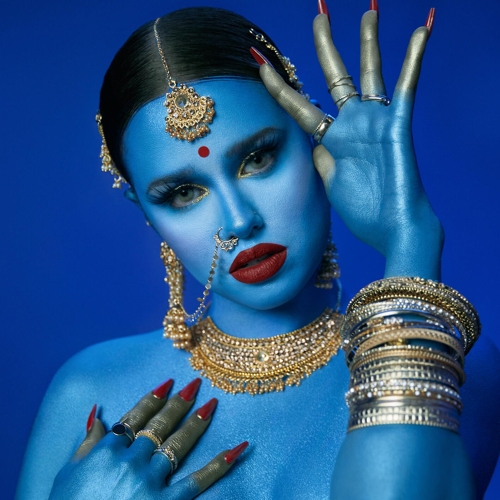


By day, Erika de Casier deals out soft-spoken come-ons and kiss-offs via throwback R&B. By night, she’s an incognito hitmaker. Last year de Casier lent a steely edge to Floridian producer Nick Léon’s heady summer club cut “Bikini,” and in 2023 she got in the studio with K-pop group NewJeans, co-writing several songs from their Get Up EP—among them the winningly naive “Super Shy.” The Danish singer has quietly left her fingerprints all over pop’s ongoing Y2K revival, but sometimes at the cost of Erika de Casier the solo recording artist. While her last album, 2024’s Still, could often stun and delight—the laugh and twinkling chimes that kick off “Lucky” never fail to make me grin—a spate of unnecessary guest features diluted its creator’s singular talents. Entirely self-written, self-produced, and released on her own label, Independent Jeep Music, Lifetime is a deliberate recentering, de Casier’s attempt to single-handedly distill the better part of a decade into one highly potent vibe.
Forgoing her trademark nostalgia for the ’00s, de Casier has committed herself to pre-Napsterdom in spirit and sound, triangulating three high-concept pop lodestars all released between 1992 and 1998: Janet Jackson’s Janet., Madonna’s Ray of Light, and, at the apex of her altar, Sade’s Love Deluxe. Every song here fades in—how retro is that—on a bed of aqueous synthesizers, buoyed by boom-bap drums. “If you know, what I’d do, do to you,” de Casier coos on album opener “Miss,” her voice enveloped in so much reverb that it dissolves at the edges. One working title for Lifetime was Midnight Caller, an easy shorthand for seduction, mystery, and menace rolled into one. Several tracks (“You Can’t Always Get What You Want,” “The Chase,” “Two Thieves”) even incorporate what are either diegetic dial tones—a noted Janet-ism—or soundwaves shaped to convincingly mimic one.
As “Miss” yields to the hothouse piano and tabla of “You Can’t Always Get What You Want,” Lifetime takes a turn towards Pure Moods, and with that some period-accurate new-age triteness: “Health or disease—you never know what you get/Might as well live gratefully.” But de Casier delivers these songs archly and suggestively—a glimmer in her eye, liquor on her breath—and the lyric sheet is appropriately marked up with each stray “uh,” “uhmm,” “ah,” and “mmh-mhh.” On “Moan,” a spiritual successor to Jackson’s “Throb,” her hypnotic entreaty to “just make love” warps the whole track around it, as represented by an impassioned keysmash: “%!//&”//“/!!/!(()!=“##=”. The syncopated hook of “Delusional,” built around a sample immortalized by Cypress Hill’s “Insane in the Brain,” is irresistibly ear-catching, as is the way de Casier’s tongue catches on “slow mo-tion,” right before “You Got It!” kicks up a spray of seafoam. And once in a while, de Casier will hit on something profound: “The truth was in the bottom of the wine/Bordeaux can make you talk a lot,” she notes, soberly, on the trip-hop standout “December.”
If the results of Lifetime’s solo writing process are mixed, de Casier’s work behind the boards is wall-to-wall dazzling, from the extraterrestrial rave stabs that pan across the stereo field on “Seasons” to the mournful cyborg whose voice echoes her own on “December.” Beginning as a funky, TLC-style creeper, “Two Thieves” gradually grinds down to an industrial chug that would do Massive Attack proud. But there are challenges that come with jacking completely into the mainframe. Lifetime lacks a commanding, sharply defined persona at its center—a sensuous Janet, an adamant Sade Adu, a Madonna brashly taking stabs at transcendence. De Casier seems to worry about this, too. “When the light’s out/Do you still see me,” she ponders aloud on the record’s title track, but one can’t be sure what to look for, other than “lipstick, blush, eyes half open and a feeling that’s so bold.” Then again, the best operatives never make the front page. Here is a master of soft power at work.
ALBUM REVIEWS

Grandeur sits at the heart of ‘This Music May Contain Hope’, RAYE’s second album, and the result feels nothing short of breathtaking. On this record, the singer born Rachel Keen explores a wide spectrum of sounds across its 73 minute length, moving from emotional ballads to lively funk moments and the jazz pop style she has become closely associated with. It can feel overwhelming at first, yet the magic that comes from RAYE fully committing to her vision makes the experience rewarding from start to finish.
‘This Music May Contain Hope’, a conceptual project about pushing through insecurity and heartbreak, unfolds like a lavish stage production. RAYE takes on the dual role of main character and guiding voice throughout the story. “Allow me to set the scene. Our story begins at 2:27am on a rainy night in Paris. Cue the thunder,” she says during the opening track ‘Girl Under The Grey Cloud’, which arrives with sweeping orchestral strings. Spoken passages appear across the album, helping shape the narrative and giving the project a sense of direction, almost like hearing the official recording of a Broadway show.
With this framework in place, the South London artist allows herself to fully explore the album’s diverse musical palette, and most of the time it works in her favor. Sometimes she fully embraces the theatrical side of the concept, especially during the closing section of the smooth R&B track ‘The WhatsApp Shakespeare’. Other moments are delivered more straightforwardly, such as the emotional slow building ballad ‘I Know You’re Hurting’. She also revisits her earlier dance influences with the impressive house track ‘Life Boat’.
Across the entire album, two things stand out clearly. RAYE’s flexible vocals sound better than ever, and her songwriting feels sharper than it has before. Take the playful highlight ‘I Hate The Way I Look Today’, a swing jazz inspired track reminiscent of Ella Fitzgerald, where she admits “I’m okay to be lonely / If I’m lonely and skinny / I have such silly self-loathing thoughts, it seems”. Then there is the emotional storytelling in ‘Nightingale Lane’: “It was right there, early June / Next to Old Park Avenue / Standing in the rain, I watched him walk away”.
Despite all the vulnerability and emotional struggles explored throughout the record, RAYE ultimately reaches a place of optimism, staying true to the album’s title. She gathers her close friends on ‘Click Clack Symphony’ with support from Hans Zimmer, finds closure with guidance from Al Green on the smooth seventies soul inspired ‘Goodbye Henry’, and reaches toward something greater alongside her sisters Amma and Absolutely on the uplifting ‘Joy’ as she searches to be “free of all the pain and every fear”. After the stormy opening imagery of that “rainy night” and “thunder”, RAYE eventually realizes that “the sun exists behind the clouds”, as she shares on ‘Happier Times Ahead’.
‘This Music May Contain Hope’ shows RAYE performing at her absolute peak. The album feels huge in scale and emotionally powerful, yet it remains rooted in honest experiences and real feelings. Yes, it asks a lot from the listener, but that is also what makes it so special. Every dramatic moment and musical shift feels like RAYE claiming her independence and finally creating music entirely on her own terms.